Don’t leave me this way
Posted on August 10, 2014 1 Comment
My long lost friend Hebert and I just connected on Facebook. Here’s his chapter from my book Stonewall to Obama.
Don’t Leave Me This Way
When I returned from Pentwater, it was obvious that the relationship with Charles was over. I couldn’t stay sober and live with a raging alcoholic. I needed to find a place of my own and start a new life. I felt completely alone. Rich had moved back to Columbia County and I had no other friends to turn to. I was spiritually bankrupt. Grace, or God or even Sheila, call it what you will, a divine force intervened on my behalf. Mom sent me a check and I moved into a small studio near the Christian Science Center in Boston’s Back Bay. Somehow I was introduced to a group of drag queens in need of wardrobe help for Halloween. The thing is you never really know you’ve been touched by an angel until after the fact. These girls loved me until I could love myself. The queen diva, John or Diana, as he preferred to be called, was planning on embodying Diana Ross for the holiday. He or she – pronouns are so limiting, don’t you think – was preparing to win the costume contest at Metro, the largest dance club in Boston. The grand prize was a thousand dollars and Diana needed that money to pay her rent. She engaged me to design a prize-winning outfit that would transform her into Diana Ross, if only for a brief shining moment. Her budget was $100. So, if she won, she would be multiplying her investment tenfold. She promised me a cut of the till – I was in. I’ve always loved combining creativity and money with music and fashion. We started in earnest to create Diana.
The look we were striving for was Ross at the height of her celebrity – the star who sang in the rain in Central Park – the glittering and sparkling sequin and feather loving Diana. We fitted her with a white sequin body suit with strings of bugle beads cascading from the neckline. We topped her off with a floor-length white sequin wrap that was trimmed in marabou feathers. The fabric and feathers alone went well over $100. I donated my talent and time to the project knowing that I would be paid in earnest, if Diana won the grand prize. Every night I would go home and bead off – literally. Not to be outdone, Diana had two drag queen “sisters” that needed costumes as well. I worked on dresses for Sheerah who was going as Mae West and Tommy who would become Ethel Merman. Each outfit was as intricate and time-consuming as Diana’s. But, I poured all my love into the Diana ensemble. Somehow I knew that it needed to be special.
Halloween night came and we all headed off to a warm-up party, then onto The Metro. At midnight, finally, Diana took the stage and performed Ross’s classic, The Boss. The crowd was mesmerized. Just like Aunt Eileen had become Diana in Grandma’s living room, so many years ago, John channeled the pop diva with perfection. No one in the audience would know that the sparkling star on the stage was really a bald white man. Age, gender and race had been erased by fashion, makeup and lots of love. Of course, Diana took first place that night and she stuffed two hundred dollars into my pocket as we gyrated on the dance floor surrounded by Diana’s awestruck fans. The sound system at Metro was amazing and the DJ was fierce – you could always count on hearing the best music at Metro. We danced the night away, reveling in the glow of victory. Suddenly the DJ spun The Cummunard’s ‘Don’t Leave Me This Way’ into the mix. The song’s gospel sound had become an anthem for the gay rights movement and also held special meaning for those dying from AIDS. Our brothers, in the prime of their life, were leaving us left and right. The AIDS death knell crept closer and closer. But, I had yet to meet or know anyone with AIDS or, God forbid, anyone that actually died from the disease. ‘Don’t Leave Me This Way’ topped the UK charts for four weeks in September 1986, becoming the biggest selling record of the year in the process. Lead singer Jimmy Somerville and featured guest vocalist, Sarah Jane Morris, were everywhere that fall. The song only reached #40 on the US Billboard Hot 100 but did top the Billboard Dance chart.
As I walked home that night, exhausted but exhilarated, I suddenly realized that I had just experienced one of the most satisfying nights of my life without any drugs or alcohol. Finally, I was participating in my life. I showed up for my friends and my creativity and work were part of a winning team. It had been just over 90 days since I’d given up booze and already my life was being transformed. I had been set free. “This must be what gratitude feels like,” I thought. “I like it. I want more of it.”
* Charles died of AIDS on December 16, 1995.
Get your copy of Stonewall to Obama here.
The legend of Spook Rock
Posted on August 9, 2014 Leave a Comment

The ghosts in Claverack seemed much older, almost as if they had been there forever. Just past the Marilyn house there was a street by the Claverack Creek called Spook Rock Road. Spook Rock was one of Dad’s favorite spots to swim. One day when we were swimming he told us the legend of Spook Rock. Sometimes our words and actions, the stories of our lives, reverberate through the canyons of time. Once in a while, when the wind is just right, we recognize our own echoes.
There once was a beautiful Indian princess who fell in love with a boy without her father’s blessing. The two young lovers decided to flee the safety of their tribe to marry. In their flight, the two youths paused to rest on a boulder in the creek. By breaking Indian tradition and religious laws they greatly angered the tribe’s gods, who upon seeing them at the rock caused a great flood. The angry waters carried the lovers to their death. The boulder and the spirits of the lovers came to rest along the banks of the stream near Spook Rock. The young maiden’s spirit supposedly haunts the spot that has become Claverack’s most precious swimming hole. Supposedly, at certain times of the year, a low moaning sound may be heard in the wind as it sweeps across the river from the Catskills. The spirit of the dead maiden remains to this day in constant search of her lost lover.
The Hudson-Athens Lighthouse
Posted on August 8, 2014 2 Comments
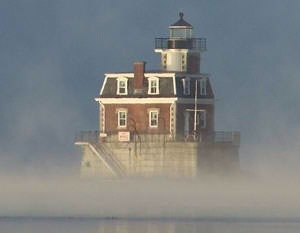
At the back of the property, behind the carriage house, the land sloped downward and ran all the way to the railroad tracks and beyond that, the Hudson river and the magnificent Hudson-Athens lighthouse. The views of the Hudson and the lighthouse must have been stunning when the house was first built. But, by now the area between the carriage house and the railroad tracks was dense with trees, bushes and vines.
The jungle, as we called it, was a great place to play and we often went off on adventures like the explorer Henry Hudson. Getting to the river though, required navigating across the train tracks. This didn’t seem like a big deal to me. But, Grandma told us the story of Dudley Gifford who had died trying to cross the tracks. Gram was always telling stories that instilled fear in us. It was her way of keeping us safe. It worked – my mind began to imagine young Dudley playing on the train tracks that his Great Great Grandfather built when suddenly a locomotive roared through crushing his legs and splattering blood everywhere. What a horrible death for an 8 year old boy.
Gram’s story was enough to keep me from ever crossing the train tracks – I’d stay in the house where it was safe. But, BJ wasn’t buying the tale. So, off we went on another adventure. This time we’d capture the lighthouse…
Marilyn Monroe Slept Here
Posted on August 7, 2014 Leave a Comment

The drive from Nanny and Poppy’s house in Claverack to Grandma and Grandpa’s house in Hudson was about 5 miles. The route is filled with some of Columbia County’s most historic homes. It passes by the Cedar Park cemetary where all the Giffords are buried. My favorite site though, was the Marilyn Monroe house, just a few homes down the street from Nanny and Poppy’s.
The early Italianate mansion was built in 1848 as a wedding gift to Catherine Bushnell from her parents. The stately home has a colorful history of celebrated guests including Eleanor Roosevelt, Helen Hayes, and Marilyn Monroe. It was here that Marilyn was photographed hugging a tree in that iconic white dress. Whenever we passed the house I would be transported to Hollywood and images of the screen goddess would flood my mind and heart.


Augustus Saint-Gaudens
Posted on August 7, 2014 Leave a Comment

Augustus Saint-Gaudens by Kenyon Cox
Saint-Gaudens (March 1, 1848 – August 3, 1907) was an American sculptor of the Beaux-Arts generation who most embodied the ideals of the “American Renaissance”. Raised in New York City, he traveled to Europe for further training and artistic study, and then returned to New York, where he achieved major critical success for his monuments commemorating heroes of the American Civil War, many of which still stand. In addition to his famous works such as the Robert Gould Shaw Memorial on Boston Common and the outstanding grand equestrian monuments to Civil War generals John A. Logan, atop a pedestal done by the architectural firm of McKim, Mead and White.
Saint-Gaudens also designed the statue of Diana that crowned Stanford White’s Madison Square Garden. The two men were fast friends and brothers of vice as founding members of the Sewer Club.
Robert Fulton the artist
Posted on August 6, 2014 Leave a Comment

Miniature portrait of Robert Fulton by Thomas Sully
In researching my new book, I stumbled across this minature portrait of Robert Fulton painted by Thomas Sully. It has intrigued me to do further research on the early American art movement of miniature. But, that’s another book entirely.
Fulton (born Nov. 14, 1765, Lancaster county, Pa., U.S.died Feb. 24, 1815, New York, N.Y.) U.S. inventor and engineer. Born to Irish immigrant parents, he studied painting with Benjamin West in London but soon turned to engineering. After designing a system of inland waterways, he tried unsuccessfully to interest the French and British governments in his prototypes of submarines ( Nautilus) and torpedoes. In 1801 he was commissioned by Robert R. Livingston to build a steamboat, and in 1807 Fulton’s Clermont made the 150-mi (240-km) journey up the Hudson River from New York City to Albany in 32 hours, cutting 64 hours off the usual sailing time. It became the first commercially successful steamboat in the U.S. He later designed several other steamboats, including the world’s first steam warship (1812). He was a member of the commission that recommended building the Erie Canal.
Fulton achieved fame for his invention of the steamboat, the Clermont. But, he also was a talented painter. He studied art in London and Paris before finding success in engineering. Below is a portrait he did of Benjamin Franklin.

Paywalls, Secret Gardens and the death of an American Lawyer
Posted on August 5, 2014 Leave a Comment
I’m deep in the research phase of my new book – a story about art, architecture, murder and the trial of the century. Actually it covers two major trials that involved New York County District Attorney William Traverse Jerome.
I’ve read hundreds of articles in an effort to fully understand the legal system that supported the gilded age and enabled New York City to rise as the greatest city in the world. My amazing discovery has been that in the last two years many newspaper publishers have digitized their archives allowing anyone access to a virtual worldwide library.
The sad part of the discovery is that I haven’t stumbled across one article or image from The New York Law Journal, The National Law Journal or The American Lawyer. I worked for ALM, the parent company of those publications, so I know the reason why – all their archives are walled off behind a paywall in an effort to generate revenue for the company’s sagging print media business.
I discovered this while I was still an ALM employee and researching my first book, Stonewall to Obama. I asked my boss at the time if I could have access to the company’s archives which were housed over at Lexis Nexis. I suggested that an image of each article be allowed outside of the paywall as a teaser for lay people doing research like me. If the viewer really wanted access to the article, they then could pay a one time fee – sort of like an a la carte menu. Sadly, my boss left the company and nothing was ever done about this.
The issue is indicative of a larger one in B2B publishing and that is the all too pervasive idea that B2B and B2C are seperate worlds that never intersect. I’m living proof that there are consumers that would willing pay for B2B information if they’d only let down the paywall, even temporarily.
You can read Stonewall to Obama here.
In an old house in Paris that was covered with vines…
Posted on August 5, 2014 Leave a Comment

One of our earliest encounters with the Gifford clan happened one late summer day while we were playing in the backyard. Gram had the rear door under the spiral staircase open to allow some air into the house. The grandchildren were playing in the yard along the older part of the house. My brother BJ, always the trouble maker, decided it would be a good idea to climb the vines growing along the side of the house. I knew this wasn’t going to turn out well. Gram was not going to take kindly to us climbing up her vines. But, just like Madeline said to the tiger in the zoo, “Pooh Pooh.” He grabbed ahold of one of the larger vines and began to scurry up the side of the building. Others followed until there were at least 3 cousins scaling the wall. BJ rose as high as the second floor and was headed for uncle Bill’s balcony. I preferred to stay on the ground and watch from a safer distance.
Suddenly the vine began to pull away from the building and the roots at the base of the house began to give way. As the boys swung from the side of the building and tore the vine’s roots from the ground a small headstone rose from the side of the house. Those of us at the base of the building began to dig furiously to get a better view of what the stone said. As we dug around the stone we discovered another headstone right next to the first.
The boys on the vine had now climbed down or jumped to the ground to help with our excavation. We were shouting and cheering and expected to find skeletons or even a casket. The two tiny headstones seemed very old. They had tiny angels at the top and the names of a boy and girl and the dates of their deaths. It was quite an exciting find! We all were riled up and also a bit scared that we’d somehow raised the dead.
Alex Helmer
Posted on August 4, 2014 Leave a Comment

Alex Helmer died at the Second Battle of Ypres in Belgium. His death inspired his friend John McCrae to pen the poem “In Flanders Field”.
Sunday Morning Divine
Posted on August 3, 2014 Leave a Comment
In the livingroom along with Grandma’s Steinway there was a pipe organ. Sometimes on Sunday mornings, organ music would fill the house like a clarion calling all good christians to rise. I’d tiptoe down the spiral staircase, still in my footy pajamas, to spy on whomever was making this magical music. Sometimes, when I was very small, I’d sit on the landing about half way down the stairs and just listen to the sweet sound of Grandpa playing his organ. Through the railing of the staircase I would peer out over the great central hallway and be transported to some ancient European cathedral. But, most of the time I couldn’t resist the music’s longing and I’d run down the stairs, slip through the columns at the entrance to the livingroom and climb up on the bench to sit next to Grandpa as he worked his magic on the keyboards.
 Culver McCall